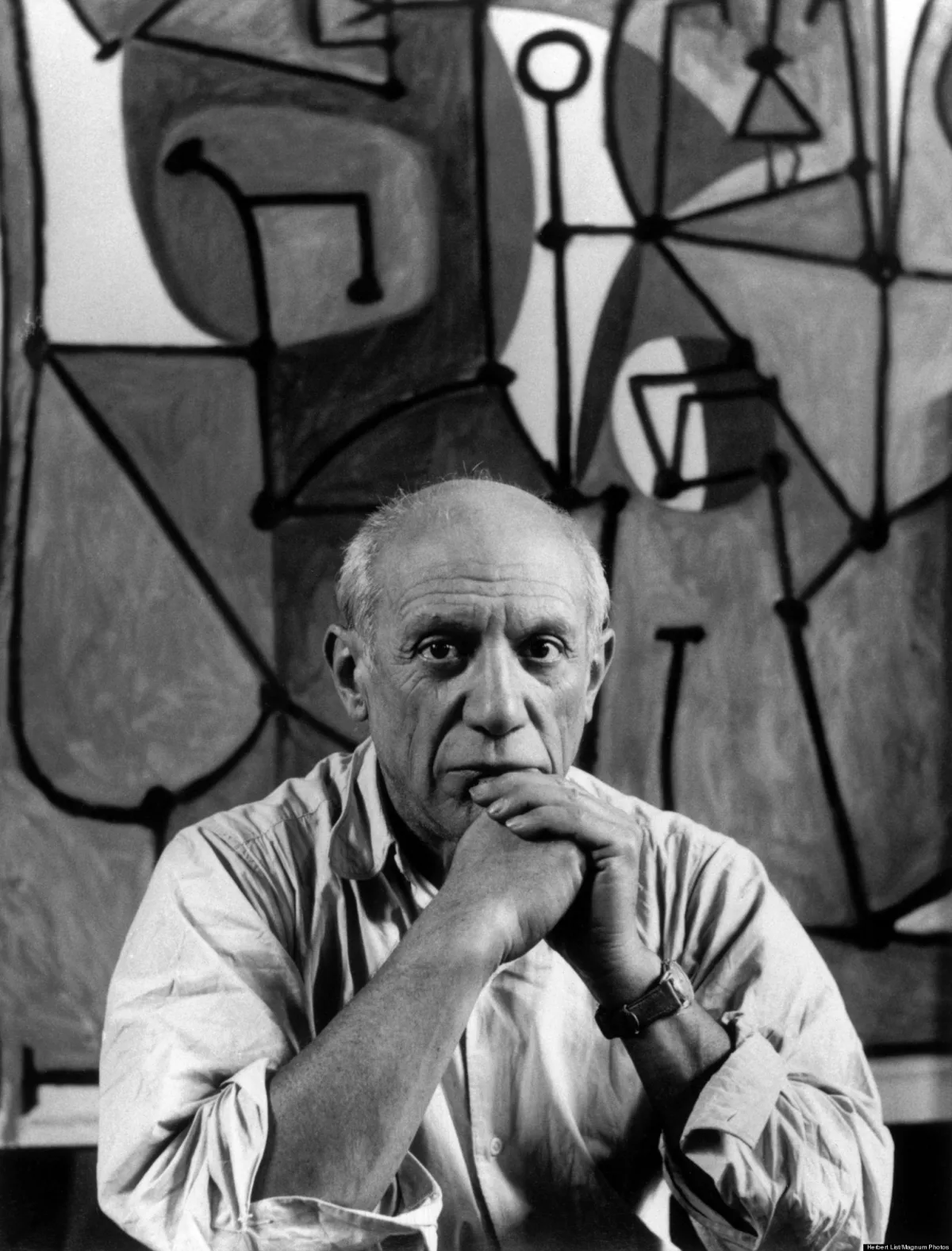
Pablo Picasso (1881-1973) was a Spanish painter, sculptor, printmaker, ceramicist and one of the most influential artists of the 20th century. He co-founded the Cubist movement, invented collage and redefined modern art with his bold experimentation and ever-evolving style.
Born in Málaga, Spain, Picasso was a child prodigy—drawing and painting from a very young age under the guidance of his father, who was also an artist. He studied in Barcelona and later in Paris, where he immersed himself in the bohemian art scene.
His early work is often divided into periods, including:
⦁ Blue Period (1901–1904): Melancholy paintings in shades of blue, often depicting the poor and the lonely.
⦁ Rose Period (1904–1906): Warmer tones and themes, including circus performers and acrobats.
⦁ African Period (1907–1909): Influenced by African tribal masks and Iberian sculpture.
⦁ Cubism (1909–1919): Along with Georges Braque, Picasso pioneered Cubism—breaking objects into geometric forms, as seen in “Les Demoiselles d’Avignon” (1907) and “Guernica” (1937), a powerful anti-war mural.
Picasso was also politically active, especially during the Spanish Civil War and World War II. His art often reflected his views, most famously in Guernica, a response to the Nazi bombing of a Basque town.
Throughout his life, Picasso produced over 50,000 artworks in a wide range of styles and mediums. He was a larger-than-life figure, known not only for his creative genius but also for his passionate, complex personal life.
He died at the age of 91 in Mougins, France, leaving behind a legacy that permanently changed the course of art history.